
Best 5 Liquor Bottle Sizes for Private Dining in Suffolk
August 11, 2026
Buying liquor for private dining can feel more complicated than it should. Bottle sizes add another layer of planning, and the wrong choice can leave you short during service or stuck with too much open inventory after the last guest leaves. In Suffolk, hosts want smooth service, clean pours, and no last-minute scrambling at the table. That is where liquor bottle sizes start to matter.
If you are planning a dinner in Suffolk County, you probably want the room to feel polished, not overmanaged. We hear this from hosts who care about pacing, presentation, and staying organized. A private dining menu can move quickly, especially when cocktails, wine, and after-dinner spirits all share the same service window. The good news is that the right bottle size makes that easier. If you want a broader planning reference, our best liquor bottle sizes for private dining in Suffolk guide can help frame the choice.
-
Mini Bottles and Airplane Bottles When Private Dining Needs a Clean Pour
Why small bottles solve the awkward math of welcome drinks and table service
Mini liquor bottles, airplane bottles, and nip bottles solve a problem that many hosts do not notice until service starts. You need enough spirit for the table, but you also need controlled pours. That matters when welcome drinks, passed trays, or pre-set cocktails are part of the plan. Small bottles create clean portion control, and they keep the bar from becoming chaotic. They also help you avoid guessing at guest counts when RSVPs shift at the last minute.
A lot of private dining in Suffolk happens in spaces where the service team has limited room to work. In those settings, a half pint liquor bottle or pint liquor setup can be too much for one course and too little for the entire event. Mini liquor bottles let you stage service more precisely. Here is the part most hosts miss: smaller bottles often reduce waste more effectively than larger ones because they match the actual serving rhythm. That is especially helpful for whiskey, gin, or tequila welcome pours.
One client in Smithtown planned a multi-course dinner with a single cocktail before the meal. They did not want bottles left open on the table, and they did not want bartenders hovering over one station. We suggested small bottles for the first round, then larger sizes for the main bar. The result was smoother pacing and less visual clutter. That kind of structure is what makes private dining feel intentional.
When mickey and nip bottles make the most sense for tastings, favors, and pre-poured cocktails
Mickey and nip bottles are strongest when the experience is about format, not volume. They work well for tastings, party favors, and pre-poured cocktails where consistency matters more than scale. If your private dinner includes a curated tasting of vodka, whiskey, or tequila, these sizes give each guest a defined serving. They also work nicely for welcome gifts or branded favor bags. Many hosts like them because they feel thoughtful without being wasteful.
You may also find them useful for cocktail ingredients that need just a measured amount. Think amaro, liqueur, triple sec, or coffee liqueur. For example, a small pre-batched espresso martini component can be easier to manage in a mini format than in a full-size bottle. If you want to explore the category more deeply, our mini bottles and airplane bottles for private events article covers the event-use angle well. Small bottles can also pair nicely with wine, hard seltzer, or canned cocktails when you are balancing multiple drink styles.
How mini liquor bottles change bar inventory, portion control, and guest pacing in Suffolk
Small bottles make bar inventory simpler because every unit has a known role. You count bottles instead of estimating free-pour behavior. That makes planning easier for a Suffolk County liquor store customer who wants clean numbers. It also helps with pacing. Guests usually drink more slowly when service comes in smaller, deliberate rounds. That can be useful for long dinners where the menu evolves course by course.
The inventory benefit is real, especially for hosts who want to buy liquor online and keep the event organized. You can segment the bar into welcome drinks, table service, and after-dinner pours. That reduces overbuying and keeps the event visually tidy. For hosts in Commack or nearby Long Island neighborhoods, that kind of planning often matters as much as the spirit choice itself. If you are comparing smaller formats, our mini liquor bottles for tastings and table service guide is a practical next read.
-
The Fifth and the 750ml Bottle Why This Is Still the Sweet Spot for Dinner Service
Why the fifth became the modern default and what that means for private dining
The fifth of liquor has a long history, and the name still gets used because it is easy to remember. It originally meant one-fifth of a gallon, which works out to about 757 ml. Today, the standard bottle is 750 ml liquor, so the old term and the modern size line up closely enough for everyday planning. That is why the fifth still feels like the default for dinner service. It is familiar, balanced, and easy to build around.
For private dining, the fifth often hits the sweet spot between too small and too large. You get enough volume for multiple guests, but you do not commit to oversized inventory. That matters when you are serving whiskey, vodka, or tequila in a refined setting. It also matters for hosts who want a standard bottle size that bartender teams recognize instantly. If you want a deeper comparison, our 750ml liquor bottles for dinner menus on Long Island article can help.
The fifth also fits well into classic bar math. It is a familiar anchor for standard bottle sizes, shot sizes, and service planning. Many seasoned bartenders still think in fifths because the math is fast. That matters when the room fills up and the bar has to keep moving. In private dining, speed should feel invisible.
How many shots are in a 750ml bottle and what that tells you about table coverage
A standard 750 ml bottle gives you roughly 17 to 18 one-and-a-half-ounce shots, depending on pour control. That is the useful number for table coverage. If you are serving neat pours, a spirit-forward welcome cocktail, or a dinner pairing flight, this tells you how far one bottle will go. It also helps you plan around how many shots in a bottle without guessing. If you need a clear breakdown, our how many shots in a 750ml bottle resource is a good reference.
The math matters because private dining rarely follows a perfect pattern. Some guests sip slowly. Some want a second round. Some stick with wine. When you know the approximate yield, you can decide whether 750 ml covers one table or just one phase of service. That is a smarter way to think about bar inventory than simply buying by instinct. It also keeps the host from overcommitting to a bottle that might not finish.
A quick rule helps here:
- 1.5 oz shot = standard restaurant pour
- 750 ml = about 25.4 oz
- Yield = roughly 17 pours
- Practical use = one medium dinner table, or several smaller pours
That simple framework keeps event planning grounded. It is also useful when you compare vodka, bourbon, or gin side by side.
When a 750ml bottle beats a liter on value per ounce for whiskey, vodka, and tequila service
A 750 ml bottle can beat a liter when the bottle will not be fully used. That is the part many hosts overlook. Pricing per ounce only matters if you actually need the ounces. If the bottle is too large for the menu, the better value is the one that gets used cleanly. That is why 750 ml sometimes wins for whiskey service at a dinner where only one cocktail round is planned.
The same logic can apply to vodka and tequila. A spirit used in only one signature cocktail may not justify a liter. The 750 ml size is also easier to manage at the table and easier to store afterward. That makes it a smart option for elegant entertaining, especially if you are pairing it with wine and champagne rather than building a full cocktail bar. When you want a direct comparison, our compare 750ml and 1 liter liquor bottles guide lays out the tradeoff clearly.
-
One Liter Bottles When the Host Wants Fewer Breaks and More Flow
Why 1 liter liquor bottles are the quiet workhorse for cocktail-heavy private dinners
One liter liquor bottles do a quiet kind of work. They are not flashy, but they reduce interruptions. If your private dinner leans cocktail-heavy, that matters a lot. Fewer bottle changes mean fewer pauses at the bar and fewer chances to lose rhythm. That is why 1 liter liquor bottles are often the best fit for cocktail-first menus.
In practice, this size works especially well for vodka, gin, rum, and tequila. Those spirits show up often in signature cocktails, and the extra volume helps service stay consistent. A liter also gives bartenders more confidence during faster rounds. In a Suffolk County private dining room, that can make the difference between polished and rushed. For hosts who want a practical reference, our 1 liter liquor bottles for cocktail-heavy private dining article is a strong starting point.
This size is also helpful when you are organizing how to stock a bar for a dinner with multiple drink preferences. You can keep the flow steady without moving immediately into oversized formats. That gives you more flexibility, especially if the menu includes both spirits and wine.
How to compare a liter against a fifth using ml to oz conversion and pricing per ounce
The simplest way to compare these bottles is with ml to oz conversion. A 750 ml bottle holds about 25.4 ounces. A 1 liter bottle holds about 33.8 ounces. That means the liter gives you roughly 8.4 more ounces than the fifth. In yield terms, that is about five to six additional standard pours. If you are weighing value, that matters.
Price-per-ounce math is straightforward. Divide the bottle price by the ounces inside, then compare the result across sizes. Even without listing exact prices, you can still see the pattern clearly: larger bottles often lower the cost per ounce, but only if you will use the extra volume. That is why the bottle size choice should follow the menu, not just the shelf label. For a more technical walkthrough, our ml to oz conversion for liquor bottle sizes page is useful.
Bottle sizeApprox. ouncesPractical use750 ml25.4 ozSmaller dinner service, focused pours1 liter33.8 ozCocktail-heavy tables, fewer refills1.75 liter59.2 ozLarger gatherings, repeated roundsThat table helps keep decisions grounded in service reality.
Which types of spirits usually make the most sense in liter format for elegant entertaining
Liter bottles are especially strong for spirits that anchor cocktails. Vodka is the obvious one because it works in many mixed drinks and stays neutral. Gin also fits well, especially if the menu includes martinis or citrus-forward cocktails. Tequila belongs in this conversation too, particularly for margarita variations and food-friendly pairings. Rum can work beautifully as well, especially spiced rum in seasonal cocktails. 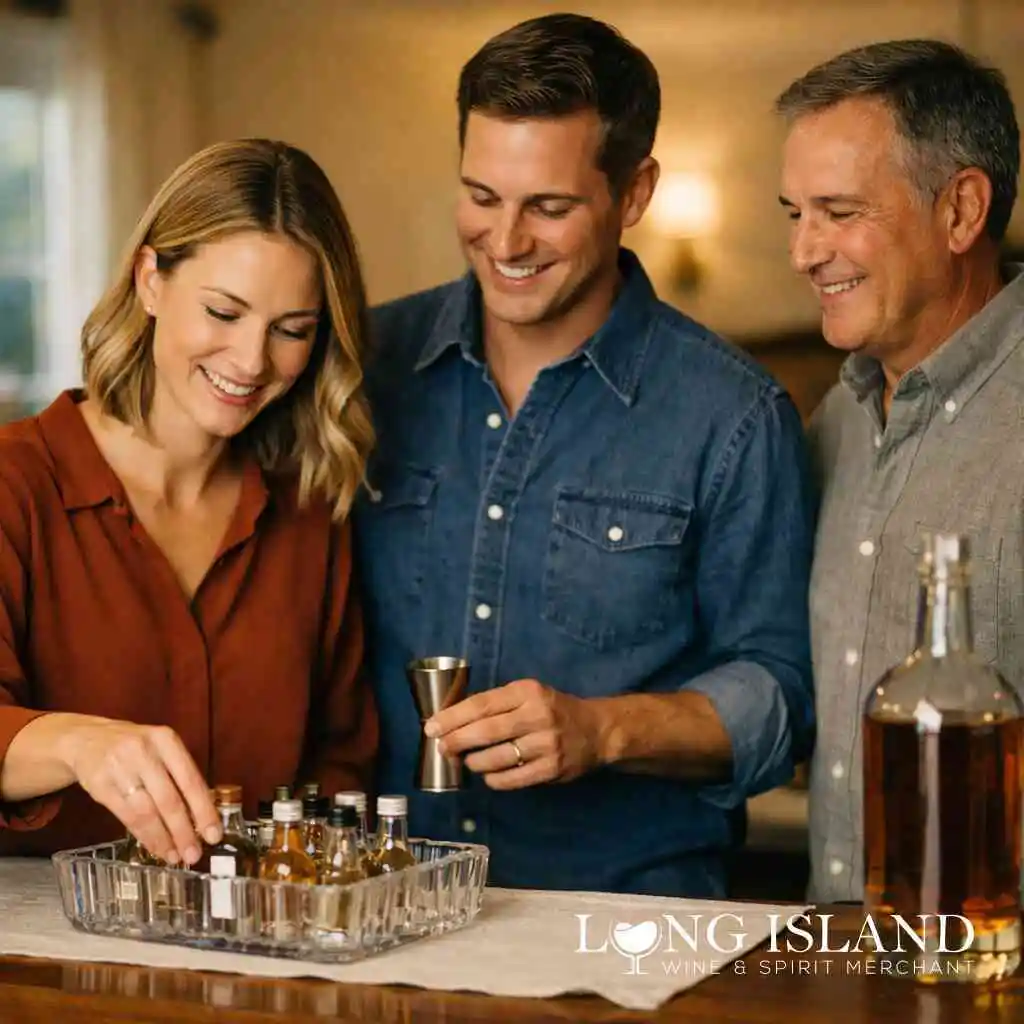
The key is to match the bottle to the usage pattern. A spirit used in several cocktails deserves a larger format. A bottle used only for one after-dinner pour may not. That is why liter bottles are often the most elegant middle ground. They support service without making the bar feel overbuilt. If you are planning a Long Island dinner with mixed beverage styles, the choice becomes much easier once you map the drinks to the courses.
-
The Handle and the Half Gallon Move That Makes Sense for Bigger Suffolk Gatherings
When 1.75 liter liquor bottles become the smartest choice for larger private dining rooms
A 1.75 liter liquor bottle, often called a handle of liquor, becomes useful when the guest count climbs and the pours keep coming. This is the size that buys breathing room. It is especially helpful in bigger private dining rooms, or when a long reception leads into dinner. You do not want the bar stopping every few minutes to swap bottles. That breaks the mood.
The handle is also easier to plan around for volume-focused spirits. Vodka, rum, gin, and tequila are common candidates because they move through cocktails efficiently. If you are serving a crowd in Suffolk County, that kind of continuity matters. It also helps with staffing, because fewer bottle changes mean fewer service interruptions. For a size-specific breakdown, our handle of liquor for larger Suffolk gatherings article is worth bookmarking.
On the projects we have helped plan this year, the handle often made sense when the host wanted one spirit to carry the entire cocktail program. That is usually a sign that the event has outgrown smaller bottles. The trick is to use that extra capacity intentionally, not automatically.
How a handle of liquor supports bar service planning without overbuying the wrong spirit
A handle of liquor can simplify planning because it reduces the risk of running out mid-event. At the same time, it can also tempt you into buying too much of the wrong bottle. That is why menu alignment matters more than bottle size alone. If the spirit only appears in one drink, a handle may be unnecessary. If it supports several cocktails, it can be ideal. That is the balance.
You should also think about alcohol shipping laws if you plan to buy liquor online. Delivery and shipping rules vary, and you want to stay within the proper channels. For local planning, people often search for a Suffolk County liquor store or a Commack liquor store when they need both convenience and service. We keep that local perspective in mind because private dining is often built on timing, not just selection. If you need help coordinating the order, our liquor services for private dining events page can point you in the right direction.
A handle also helps with bar inventory when the host wants to simplify backstock. One larger bottle is easier to track than several smaller ones. That can matter when you are juggling wine, beer, and spirits at once.
What to consider before using bulk bottles for vodka, rum, gin, or tequila service
Before you go bulk, ask one question: will the bottle get used fully and gracefully? If the answer is yes, bulk can be smart. If not, it can tie up your bar with more product than you need. Vodka is often the safest bulk choice because it is versatile and neutral. Rum works well for tropical or spiced menus. Gin and tequila are excellent too, if the cocktails are clearly defined.
You should also think about presentation. A large bottle can look efficient, but not every table or bar setup wants that look. For some dinners, a mix of 750 ml and 1.75 liter bottles creates a better balance. That approach keeps the service elegant while still providing volume. If you are stocking from a Commack liquor store for elegant entertaining, this mixed strategy is often the cleanest solution. It feels thoughtful, not overdone.
-
Choosing the Bottle Size That Matches the Room and the Menu
How to match standard bottle sizes to plated dinners, cocktail pairings, and multi-course service
The best liquor bottle sizes are the ones that match the room and the menu. A plated dinner with wine pairings usually needs less spirit inventory than a cocktail-forward reception. A multi-course meal with one signature cocktail per course changes the math again. That is why bottle choice should begin with the service pattern, not the aisle. If the menu is restrained, standard bottle sizes like mini bottles or 750 ml bottles often make the most sense. If the menu is broad, liters and handles earn their place.
This is also where types of spirits matter. Vodka and gin usually support many cocktail formats. Whiskey and bourbon often fit neat pours, digestifs, or spirit-forward cocktails. Tequila and mezcal can work for brighter, food-friendly pairings. Brandy, cognac, vermouth, and amaro often appear later in the meal, so smaller quantities may be enough. That is why a single bottle size rarely answers every need.
For hosts who want practical guidance, this is the simplest framework:
- Use mini liquor bottles for favors and tastings
- Use 750ml liquor for focused dinner service
- Use 1 liter liquor for cocktail-heavy menus
- Use 1.75 liter liquor for larger guest counts
- Mix sizes when the menu has multiple drink phases
That structure keeps service clean and avoids overbuying.
Why Suffolk County hosts should think about wine, champagne, and spirits together instead of separately
Private dining works best when the beverage plan is unified. Suffolk County hosts often think of wine, champagne, and spirits as separate decisions, but the room experiences them as one flow. A guest may start with sparkling wine, move to a vodka cocktail, then finish with cognac or amaro. If you plan each category alone, you can end up with too much of one thing and too little of another. That is where liquor and wine bottle size planning helps.
Wine deserves the same attention as spirits because it shapes pacing. Red wine, white wine, rosé, champagne, and sparkling wine all affect the rhythm of the evening. Beer, craft beer, domestic beer, hard seltzer, and canned cocktails can also fit the picture for more casual private dining. The key is coherence. When the beverage plan feels coherent, the event feels more polished. That is true in Commack, across Long Island, and anywhere hosts want the service to feel easy.
If you are comparing spirits alongside wine, our wine store and shop liquor bottle sizes guide to 2026 bar inventory pages can help you build a balanced menu without overthinking it.
What to order next from a Commack liquor store when you want private dining to feel polished and effortless
If you want the short answer, order the bottle size that fits the guest count and the number of drink rounds. Start small when service is tight. Move to 750 ml or 1 liter when cocktails are central. Choose a handle only when the volume truly supports the menu. That is the cleanest way to shop liquor online without second-guessing yourself. It also keeps the event feeling refined.
At Shop Liquor Bottle Sizes, we help people in Commack, across Long Island, and throughout Suffolk County think through those choices with less stress. If you need a liquor store in Suffolk County for private events feel, we are set up to help with bottle planning, and we ship in all 50 states. If you already know your spirit direction, you can order alcohol online for private dining and keep the rest simple. You do not have to figure out every detail tonight, and you do not need a perfect plan to get started. Pick the menu, count the pours, and choose the bottle size that makes the room feel calm.
Frequently Asked Questions
Frequently Asked Questions
Question: How do I choose the best liquor bottle size for private dining in Suffolk when planning cocktails, wine, and after-dinner spirits?
Answer: The best liquor bottle size for private dining in Suffolk depends on your guest count, drink menu, and service style. For smaller, more polished dinners, mini liquor bottles, airplane bottles, or nip bottles can be great for tastings and pre-poured welcomes. For most seated dinners, 750ml liquor bottles are often the most flexible option because they balance bar inventory, presentation, and how many shots are in a bottle. If your menu is cocktail-heavy, 1 liter liquor bottles can reduce refills and keep service moving. For larger gatherings, a 1.75 liter liquor bottle, also called a handle of liquor, can be the most efficient choice. Shop Liquor Bottle Sizes helps hosts in Commack, Suffolk County, and across Long Island think through liquor bottle sizes in a simple, practical way so the final selection matches the room instead of creating waste.
Question: What is the difference between a fifth of liquor, 750ml liquor, 1 liter liquor, and 1.75 liter liquor for private dining service?
Answer: A fifth of liquor is the older name many people still use for a 750ml liquor bottle, which remains the standard bottle size for many dinners and home bar setups. A 1 liter liquor bottle gives you more volume and is useful when cocktails are being poured throughout the evening. A 1.75 liter liquor bottle, often called a handle of liquor or half gallon liquor, is usually best when you want fewer bottle changes and smoother service for a larger table or event. The main difference is how much volume you need and how often the bottle will be used. If the spirit is being used in several cocktails, the larger format may offer better value per ounce. If it is only needed for one course or one signature drink, the 750ml bottle may be the smarter choice. Shop Liquor Bottle Sizes can help you compare standard bottle sizes with a straightforward liquor size chart approach so you can shop liquor online with more confidence.
Question: How many shots in a bottle should I expect when comparing mini liquor bottles, 750ml liquor, and 1 liter liquor for an event?
Answer: The answer depends on the bottle size and the pour, but the basic planning math is useful. A standard 750ml liquor bottle holds about 25.4 ounces, which is roughly 17 one-and-a-half-ounce shot sizes. A 1 liter liquor bottle holds about 33.8 ounces, which gives you a few more standard pours and can be helpful for cocktail-heavy service. Mini liquor bottles and airplane bottles are designed for exact portions, so they are especially useful when you want portion control for tastings, favors, or welcome drinks. When hosts in Suffolk County want to avoid running short or overbuying, understanding how many shots in a bottle makes bar inventory easier to manage. If you are not sure whether vodka, whiskey, rum, or tequila should be ordered in smaller or larger formats, Shop Liquor Bottle Sizes can guide you with the right mix for private dining, bar service planning, and no-fuss entertaining.
Question: What types of spirits work best in a 1 liter liquor bottle for elegant entertaining and cocktail-heavy menus?
Answer: A 1 liter liquor bottle works especially well for versatile spirits that show up in multiple cocktails. Vodka is often a strong choice because it can support a wide range of recipes. Gin is another smart option for martinis, citrus-forward drinks, and classic mixed cocktails. Tequila and rum also fit well when the menu includes signature drinks, food-friendly pairings, or seasonal cocktails. Whiskey and bourbon can work beautifully too, especially when the dinner includes spirit-forward drinks or neat pours. The main advantage of the 1 liter liquor bottle is fewer refills and steadier flow, which is useful in private dining rooms where the service team wants to stay polished and efficient. Shop Liquor Bottle Sizes offers a thoughtful online liquor store experience for hosts comparing essential spirits, cocktail ingredients, and value size comparison options without overcomplicating the order.
Question: Is the blog Best 5 Liquor Bottle Sizes for Private Dining in Suffolk useful if I want to buy liquor online from a Commack liquor store for a private event?
Answer: Yes. The blog Best 5 Liquor Bottle Sizes for Private Dining in Suffolk is designed to help hosts make smarter bottle decisions before they buy liquor online. It explains when mini liquor bottles make sense, when a fifth of liquor or 750ml liquor bottle is the right fit, and when 1 liter liquor or 1.75 liter liquor bottles are better for larger guest counts. That kind of guidance is especially helpful if you are shopping from a Commack liquor store or a Long Island liquor store and want the order to feel organized from the start. Shop Liquor Bottle Sizes focuses on practical bottle planning, including bar inventory, shot sizes, and matching types of spirits to the menu. Whether you are planning a Suffolk County dinner, a home bar setup, or a refined private dining event, the goal is to make liquor bottle sizes easier to understand so you can choose with confidence.


