
How to Stock a Commack NY Bar with Standard Bottle Sizes
October 22, 2026
To stock a Commack bar well, choose standard bottle sizes based on how many people you serve, how often you pour, and which spirits you use most. The right mix usually starts with 750ml liquor, adds a larger handle of liquor for high-use staples, and keeps a few mini liquor bottles on hand for variety and parties.
Key Takeaways
- Standard bottle sizes help you avoid overbuying and reduce dead stock in a home bar or party setup.
- A fifth of liquor and a handle of liquor solve different problems: one is for flexibility, the other is for volume and value per ounce.
- For most homes, a smart bar inventory starts with vodka, whiskey, gin, tequila, rum, and a few mixers, then expands based on what you actually drink.
- Shot sizes, ml to oz conversion, and price per ounce matter more than bottle shape when you compare value.
- If you want a simpler way to shop, a focused Commack liquor store like How To Stock A Commack Home can help you match bottle sizes to your event or home bar.
Why the wrong bottle size turns a simple Commack bar setup into a guessing game
The wrong bottle size makes bar inventory confusing fast. You either run out too soon or end up with expensive leftovers that never get opened. For a Commack NY home bar, the goal is not to buy the biggest bottle possible. It is to buy the size that fits your guest count, your drinking habits, and your shelf space.
What standard bottle sizes actually mean for a Commack NY home bar and party setup
Standard bottle sizes are the common formats sold for spirits, wine, and beer, and they help you compare value with less guesswork. In the U.S., the TTB standard sizes for spirits commonly include 50 ml, 100 ml, 200 ml, 375 ml, 750 ml liquor, 1 liter liquor, and 1.75 liter liquor. A fifth of liquor is the old nickname for 750 ml, while a handle of liquor is the 1.75 liter size many people buy for high-traffic bottles.
Here is the part most homeowners miss: size is about use case, not status. A 750 ml bottle works well for testing a new bourbon or setting up a small bar cart. A 1.75 liter bottle makes more sense for a house favorite, especially if you make the same cocktails often.
For a quick reference, this simple liquor size chart helps:
Bottle sizeCommon nicknameBest use50 mlmini, nip, airplane bottlefavors, travel, tastings375 mlhalf pint liquorsampling, low-commitment stocking750 mlfifth of liquorstandard home bar use1 liter—frequent mixing, better value than 750 ml1.75 literhandle of liquorparties, high-volume staplesIf you are comparing bottles for a party or gift, our comparison guide is a useful starting point. It keeps the decision grounded in volume, not hype.
Why a fifth of liquor and a handle of liquor solve different problems at the same bar cart
A fifth of liquor gives you flexibility. It is the size most people reach for when they want one bottle of vodka, gin, or whiskey without committing to a large format. A handle of liquor gives you efficiency. It lowers the need to restock and usually improves value per ounce when you know the bottle will get used.
A customer in Suffolk County once asked for “the biggest bottle” for a small housewarming. After we talked through guest count and cocktail menu, it became clear a 750 ml bottle and a few mini bottles for favors would serve the night better than one oversized bottle. That is the logic you want at your own bar cart too.
The simplest rule is this:
- Choose 750 ml when you are testing, gifting, or keeping a balanced shelf.
- Choose 1 liter when a spirit is a regular mixer.
- Choose 1.75 liter when the bottle disappears quickly.
- Choose half pint liquor or mini bottles for sampling, travel, or party favors.
The bottle-size playbook that makes bar inventory feel effortless instead of expensive
The easiest bar inventory is built in layers. Start with a few core spirits in 750 ml, move up to 1 liter for bottles you use often, and reserve 1.75 liter formats for house staples. That approach keeps cash tied up in bottles you actually open, not bottles that sit for months.
How to match mini liquor bottles, 750ml liquor, 1 liter liquor, and 1.75 liter liquor to real guest counts
Bottle size should follow the number of drinks you expect to pour. For a quiet weeknight, a 750 ml bottle is usually enough for several cocktails or mixed drinks. For a dinner party or backyard gathering, a 1 liter bottle gives you extra margin. For a bigger crowd, a 1.75 liter bottle is the better anchor. A practical way to think about it: Guest countGood starting sizeWhy it works2-4 people375 ml to 750 mlSmall volume, low waste5-10 people750 ml to 1 literEnough for several rounds10+ people1.75 literBetter for repeated poursIf you are building a home bar from scratch, a focused guide like How To Stock A Home Bar can help you decide what belongs on the shelf first. That matters if you live in Commack, travel across Long Island, or prefer to buy liquor online instead of making extra store runs. 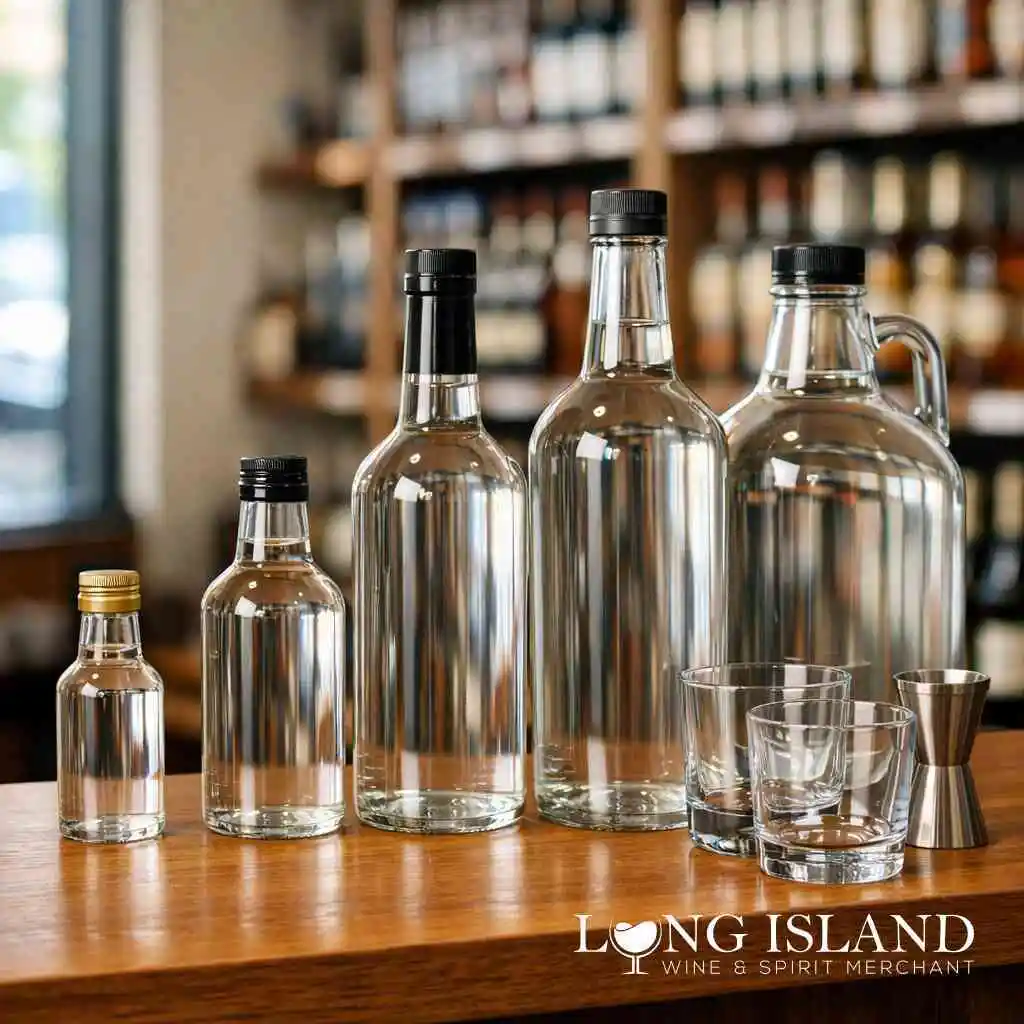
Mini liquor bottles, airplane bottles, and nip bottles are useful for more than novelty. They are smart for sampling, for custom cases, and for keeping a few backup spirits on hand without opening a full bottle. They also work well if you want variety in a small fridge or bar drawer.
When shot sizes, ml to oz conversion, and price per ounce change what belongs on your shelf
Shot sizes matter because they tell you how far a bottle goes. In most U.S. bars, one shot is 1.5 oz, or about 44 ml. That means a 750 ml bottle contains roughly 17 standard shots, a 1 liter bottle contains about 22, and a 1.75 liter bottle contains about 39. Those are useful planning numbers for home bartending and party planning.
Here is a simple conversion guide:
- 50 ml = about 1.7 oz
- 375 ml = about 12.7 oz
- 750 ml = about 25.4 oz
- 1 liter = about 33.8 oz
- 1.75 liter = about 59.2 oz
Price per ounce changes the picture. A larger bottle often gives better value per ounce, but only if you finish it. If you do not, the lower ounce price is irrelevant. That is why a bottle size comparison should always include your actual use pattern, not just the sticker size.
For more background on format differences, our size explanation page is a strong reference. If you want the regulatory side, the Alcohol and Tobacco Tax and Trade Bureau explains U.S. labeling and container rules in plain terms.
What to buy first when you want a bar that works for weeknights, holidays, and last-minute guests
Start with essential spirits that cover the widest range of drinks, then add wine, beer, and a few mixers. A smart Commack bar does not need everything. It needs the right core bottles in the right sizes so you can make a cocktail, pour a neat drink, or welcome a surprise guest without scrambling.
Which types of spirits anchor a smart Commack liquor store bar mix from vodka and whiskey to gin and tequila
The best home bar essentials are the spirits you will actually use. For most homes, that means vodka, whiskey, gin, and tequila first, then rum and a few specialty bottles. If your household leans toward bourbon, scotch, rye whiskey, or mezcal, swap the mix to fit your taste instead of following a generic checklist.
A flexible starter shelf usually looks like this:
- Vodka for mixed drinks and easy crowd-pleasers
- Whiskey or bourbon for straight pours and classic cocktails
- Gin for martinis, spritzes, and citrus drinks
- Tequila or mezcal for margaritas and seasonal cocktails
- Rum or spiced rum for tiki drinks and simple mixers
- Vermouth and amaro for aperitif-style drinks
- A few liqueurs like Baileys, Kahlua, triple sec, or blue curaçao
If you are browsing spirits by category, a nearby whiskey guide can help you match style and size without overbuying. The same logic works for wine selections if you want to stock red wine, white wine, rosé, champagne, or sparkling wine alongside your spirits.
For mixers and backup bottles, think practically. Beer, craft beer, imported beer, domestic beer, hard seltzer, and canned cocktails all help round out a weekend fridge without requiring a full bar setup. If you host often in Commack or across Suffolk County, a balanced mix of liquor bottles and ready-to-serve options keeps you covered.
The National Institute on Alcohol Abuse and Alcoholism has useful general information on alcohol effects and standard drink concepts, which can help you pour more mindfully: NIAAA guidance. That is worth knowing before you stock a shelf too heavily.
A strong local option is Shop Liquor Bottle Sizes, especially if you want to buy liquor online, compare bottle formats, or arrange liquor delivery without guessing. We also serve customers looking for a Commack liquor store feel with Long Island reach and shipping in all 50 states.
If you want the simplest next move, pick your core spirits, decide which ones deserve 750 ml versus 1.75 liter, and then place one order that matches your real drinking habits. You do not need to stock everything today. Start with the bottles you know will get opened, then build from there through our ordering options.
People Also Ask
What are the standard liquor bottle sizes in the US?
The most common standard sizes for spirits are 50 ml, 100 ml, 200 ml, 375 ml, 750 ml, 1 liter, and 1.75 liter. In everyday speech, people often call 50 ml a mini, nip, or airplane bottle, 375 ml a half pint, 750 ml a fifth, and 1.75 liter a handle.
Is a fifth of liquor the same as 750 ml?
Yes. A fifth traditionally meant one-fifth of a gallon, which is about 757 ml. Today, the standard bottle is 750 ml, and people still call it a fifth of liquor.
How many 1.5 oz shots are in a liter?
A 1 liter bottle contains about 22 standard 1.5 oz shots. That is a useful number for party planning, home bartending, and comparing value across bottle sizes.
Does Shop Liquor Bottle Sizes ship to all states?
The site says it offers shipping in all 50 states. Alcohol shipping laws can vary by state, so it is smart to review the shipping details before you order and make sure the destination is eligible.
Which liquor bottle size is best for parties?
For many parties, 1.75 liter bottles work well for the most popular spirits because they reduce restocking. For smaller gatherings, 750 ml or 1 liter bottles may be the better fit if you want less waste and more variety.
What is the best way to compare bottle value?
Use price per ounce, not just sticker price. Divide the bottle price by the total ounces, then compare that number across 750 ml, 1 liter, and 1.75 liter sizes. That gives you the cleanest value comparison.
Frequently Asked Questions
Question: In How to Stock a Commack NY Bar with Standard Bottle Sizes, which liquor bottle sizes make the most sense for a home bar in Commack?
Answer: For most Commack home bars, the best starting point is a mix of 750 ml liquor, 1 liter liquor, and 1.75 liter liquor. A fifth of liquor works well when you want flexibility and variety, while a handle of liquor is better for high-use essentials like vodka, whiskey, rum, or tequila. Mini liquor bottles, airplane bottles, and nip bottles are also useful for tasting, party favors, and keeping a few backup options without opening a full bottle. If you are building bar inventory from scratch, Shop Liquor Bottle Sizes is a practical Long Island liquor store option because it helps you match standard bottle sizes to real drinking habits instead of overbuying bottles that sit unused.
Question: How do shot sizes and ml to oz conversion help me compare bottle value before I buy liquor online?
Answer: Shot sizes and ml to oz conversion make bottle size comparison much easier. In the U.S., a standard shot is usually 1.5 oz, so a 750 ml liquor bottle gives you about 17 shots, a 1 liter liquor bottle gives you about 22 shots, and a 1.75 liter liquor bottle gives you about 39 shots. That matters when you are comparing pricing per ounce and trying to decide whether a fifth of liquor or a handle of liquor is the better fit. Shop Liquor Bottle Sizes makes this kind of planning simpler because you can shop by liquor bottle sizes instead of guessing which format gives you the best value for your home bar, party planning, or liquor delivery needs.
Question: What essential spirits should I stock first at a Commack liquor store for a balanced home bar?
Answer: A smart home bar usually starts with the essential spirits that cover the widest range of drinks: vodka, whiskey, bourbon, gin, tequila, rum, and sometimes vermouth or a liqueur like Baileys, Kahlua, triple sec, or blue curaçao. If you like classic cocktails, you may also want scotch, rye whiskey, mezcal, brandy, cognac, or amaro depending on your taste. The goal is to build a bar inventory around what you actually pour most often, then choose standard bottle sizes that match that usage. Shop Liquor Bottle Sizes is helpful because it offers a wide range of liquor bottles for different types of spirits, so you can stock a bar that works for weeknights, holidays, and last-minute guests without filling your shelf with bottles you do not need.
Question: Does Shop Liquor Bottle Sizes help with bar inventory planning for parties, gift liquor, and mini bottles for favors?
Answer: Yes, that is exactly the kind of planning standard bottle sizes are meant to support. For smaller gatherings, 375 ml or 750 ml bottles may be enough, while larger parties often call for 1 liter liquor or 1.75 liter liquor for high-volume spirits. Mini liquor bottles, airplane bottles, and nip bottles are also a smart option for mini bottles for favors, sampler packs, or small custom cases. Shop Liquor Bottle Sizes is set up for this kind of flexible shopping, whether you want gift liquor, liquor gift sets, seasonal liquor, or a simple way to buy liquor online and keep your event organized. It is especially useful if you want a Commack liquor store feel with the convenience of an online liquor store.
Question: Are standard bottle sizes from Shop Liquor Bottle Sizes useful for comparing value, bulk liquor, and wholesale liquor options?
Answer: Yes. Standard bottle sizes are one of the easiest ways to compare value because they let you look at price per ounce instead of only looking at the label size. That is helpful whether you are buying a fifth of liquor for flexibility, a handle of liquor for heavy-use staples, or larger formats for events and bar setup for parties. Bigger bottles often offer better pricing per ounce, but only if you will actually finish them, so the right choice depends on your drinking habits and bar inventory needs. Shop Liquor Bottle Sizes is a strong option for value size comparison because it lets you browse liquor bottle sizes in a way that supports home bartending, party planning, and even bulk liquor style stocking without forcing you to guess which format fits best.
Question: Can I use Shop Liquor Bottle Sizes to stock a Long Island liquor store style bar for wine, beer, and canned cocktails too?
Answer: Yes. A well-rounded home bar is not only about spirits. Many people also want wine, red wine, white wine, rosé, champagne, sparkling wine, beer, craft beer, imported beer, domestic beer, hard seltzer, and canned cocktails to round out the fridge and make hosting easier. That is why a complete bar inventory should include cocktail ingredients and a mix of bottle sizes that works for both spirits and ready-to-serve options. Shop Liquor Bottle Sizes is useful here because it brings together liquor bottles, wine, and other party-friendly options in a way that supports stocking a bar for everyday use, holiday liquor gifts, and last-minute guests. It is a practical choice for anyone looking for a Commack liquor store or Long Island liquor store approach to home bar essentials.


