
Comparing Shot Sizes and How Many Shots in a Bottle 2026
July 11, 2026
You need to buy liquor for a party, but the bottle sizes feel oddly slippery. That confusion is normal. The same drink can look generous at one bar and tight at another. If you are reading this at 11 p.m. with a guest list in hand, take a breath. The numbers are manageable once you know the basics.
Why the bottle in your hand may not tell the whole shot story
The standard shot size most people mean when they say one shot
A standard shot size in the United States usually means 1.5 ounces. That is the measurement most bartenders use for a straightforward pour. It also equals about 44 milliliters, which helps when you are comparing imported labels. Some bars pour less, and some recipes call for more, so the glass can fool you. That is why comparing shot sizes and the standard shot size matters before you stock up.
Here is the part most shoppers miss. A shot is not a bottle size; it is a pour size. So when someone asks how many shots in a bottle, the answer depends on the bottle and the pour. A 750ml bottle, for example, contains about 25.4 ounces. Divide that by 1.5 ounces, and you get roughly 16 shots. If you pour 1-ounce drinks, the count changes fast.
One client in Commack recently planned a backyard dinner and thought two bottles would be plenty. The math changed once they realized their cocktails used 2 ounces each. That is a common surprise. It is also why a good liquor size chart saves stress before guests arrive. The bottle does not lie, but the pour often does.
Why a 750ml bottle and a fifth of liquor still confuse shoppers in Commack and beyond
A fifth of liquor is one of those old terms that still hangs around. Historically, it meant one-fifth of a gallon, which was about 757 milliliters. Today, the standard shifted to 750ml liquor, so the old nickname stuck even though the math changed slightly. That tiny gap creates real confusion. People hear “fifth” and picture a size that is not quite the same as the modern label.
This comes up often in a Commack liquor store conversation. A shopper will ask for a fifth, then spot a 750ml bottle and wonder if it is different. The answer is simple: it is the modern equivalent. If you want to buy liquor online or compare shelves at a Long Island liquor store, knowing this saves time. It also helps when you shop a New York liquor store from Suffolk County to Nassau County.
Here is what almost no online guide mentions. Bottle names are often older than the packaging rules around them. That is why people still say fifth, even when the label says 750ml. The language survives because customers use it. The bottle survived because the industry standardized it.
When bar pours, home pours, and cocktail recipes quietly change the math
A recipe may call for 1.5 ounces, but home pours often drift upward. That happens because people pour by feel. Bars face the opposite issue. They often measure tightly to protect margins and keep bar inventory accurate. So the same drink can yield different shot counts depending on where you taste it.
That difference matters when you plan a party or a home bar. If you are making margaritas, martinis, or old fashioneds, your cocktail ingredients may consume liquor faster than expected. A 2-ounce pour cuts your shot count sharply. A 1-ounce pour stretches a bottle longer, but it changes the drink balance. The best move is to match the recipe, not the memory of the recipe.
The question we get more than any other from first-time hosts is simple: “Will one bottle really cover the night?” Sometimes yes, sometimes no. The answer depends on ABV, recipe strength, and how many guests want full cocktails instead of neat pours. That is why a rough count helps, but a clear plan helps more.
The liquor size chart that turns ounces into real party planning
How many shots in a bottle from mini liquor bottles to a handle of liquor
A good liquor size chart turns guesswork into planning. It lets you move from mini liquor bottles to a handle of liquor without losing the thread. Mini bottles, also called airplane bottles or nip bottles, are usually 50ml. That is about 1.7 ounces, or roughly one standard shot. A half pint liquor bottle is larger, and a pint liquor bottle is larger still.
For quick reference, here is a practical shot-count snapshot using a 1.5-ounce standard pour:
Bottle sizeApprox. ouncesApprox. shots50ml mini bottle1.7 oz1 shotHalf pint liquor6.8 oz4 to 5 shotsPint liquor12.7 oz8 to 9 shots750ml liquor25.4 oz16 shots1 liter liquor33.8 oz22 to 23 shots1.75 liter liquor59.2 oz39 shotsThat table works well for party planning and home bartending. It also helps when you compare how many shots in a bottle across different products. The counts rise quickly as the bottle grows. A handle of liquor gives you more breathing room for a wedding, reunion, or house party. If you are shopping for the best liquor bottle size for parties, the handle is usually the safest volume choice.
A customer from Smithtown once called about a graduation cookout with twenty people. They thought three 750ml bottles would cover everything. After we walked through the pour math, they shifted to larger sizes and a few minis for variety. That saved them from running short halfway through dessert. Simple math prevents awkward endings.
What changes when you compare half pint liquor, pint liquor, 750ml liquor, 1 liter liquor, and 1.75 liter liquor
Size changes more than storage space. It changes value, flexibility, and waste. A half pint liquor bottle is great for sampling or travel. A pint liquor bottle works for a small gathering or a specific cocktail. A 750ml liquor bottle remains the standard choice for many households. A 1 liter liquor bottle adds breathing room. A 1.75 liter liquor bottle, often called a handle, works best when volume matters most.
The standard bottle sizes under TTB standard sizes make this comparison easier. In the U.S., you commonly see 50ml, 100ml, 200ml, 375ml, 750ml, 1L, and 1.75L. Outside the U.S., EU bottle sizes and other metric formats can look different. That is where metric vs imperial confusion creeps in. Once you know the conversion, the label becomes far less intimidating.
If you are comparing a fifth, a liter, and a handle, the question is not just quantity. It is also use case. Smaller bottles fit tasting nights and liquor bottle reuse projects. Larger bottles reduce bottle count and may support more eco-friendly bottle sizes behavior. Here is the honest rule: smaller sizes give flexibility, but larger sizes often win on convenience.
The value size comparison behind price per ounce, bar inventory, and the best liquor bottle size for parties
The smartest shoppers look at pricing per ounce. That number tells you more than the sticker on the shelf. A bottle can look cheaper and still cost more per pour. Larger formats often improve value because packaging costs spread across more liquid. That is not always true, but it is often true enough to matter.
Here is how to think about it in plain terms:
- Smaller bottles help with sampling and gifting.
- Mid-size bottles work well for modest home bars.
- Larger bottles usually support better per-ounce value.
- Specialized bottles make sense when you need variety, not volume.
This is where value size comparison becomes practical, not theoretical. If you build bar inventory for a weekend event, you want enough volume and enough flexibility. If you stock a home bar, you may need one large bottle of vodka, one bourbon, and one gin before anything else. That is the backbone of how to stock a bar without overbuying. For many people, the right answer is a mix, not a single bottle size.
We see that pattern often in Commack and across Long Island. A host wants quality, but also fewer leftover bottles after the party. A handle can be efficient. Minis can fill gaps. A 750ml bottle can sit in the middle and cover a lot of everyday use. The best choice depends on your guest list, your cocktails, and how often you pour.
How historical bottle names like jeroboam, methuselah, and nebuchadnezzar fit into modern shopping
The big names sound dramatic because they are dramatic. Jeroboam, rehoboam, methuselah, salmanazar, balthazar, and nebuchadnezzar come from old bottle naming traditions, especially in wine and sparkling wine. These names are part of the story behind historical bottle names, and they still show up in premium collections. People hear them and assume they are random. They are not. They usually mark very large formats. For everyday liquor shoppers, these names matter mostly as context. You may not need a double magnum or a half gallon liquor bottle for a weekday dinner. But knowing the terms helps when you compare standard bottle sizes with oversized celebration formats. It also helps if you enjoy learning how wine bottle sizes and sparkling wine formats evolved. The naming tradition is old, but the buying decision is modern. 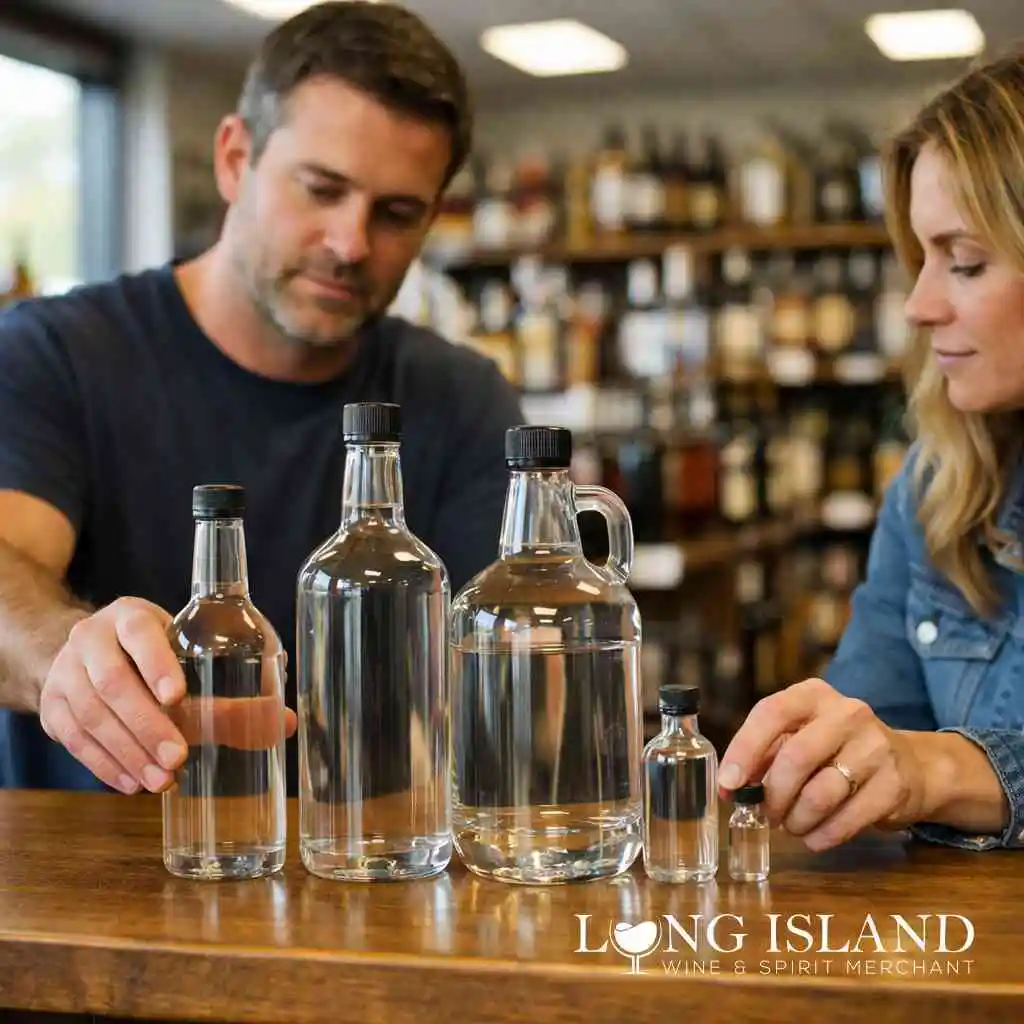
If you see a special bottle name on a label, do not panic. Read the milliliters. Then convert to ounces. Then estimate servings. That sequence works every time. It also prevents overbuying when you are planning for a holiday, birthday, or company dinner.
What smart buyers do next before they stock the bar
Using ml to oz conversion and ABV proof to choose the right bottle for vodka, whiskey, bourbon, rum, gin, tequila, and wine
ML to oz conversion is the quiet tool behind smart buying. One ounce equals about 29.57 milliliters. So a 750ml bottle gives you about 25.4 ounces. A 1 liter bottle gives you about 33.8 ounces. A 1.75 liter bottle gives you about 59.2 ounces. Those numbers help you compare real volume instead of guessing by shape.
You should also look at ABV and proof. ABV means alcohol by volume. Proof is the older measure, and in the U.S. it is usually double the ABV. A 40% ABV spirit is 80 proof. Higher-proof bottles can affect cocktails faster, even when the bottle size is the same. That matters for vodka, whiskey, bourbon, scotch, rye whiskey, rum, spiced rum, gin, tequila, mezcal, brandy, cognac, amaro, liqueur, Baileys, Kahlúa, triple sec, blue curaçao, and coffee liqueur.
Different spirits also play different roles. Whiskey and bourbon often anchor a home bar. Gin and tequila anchor cocktails. Wine, red wine, white wine, rosé, champagne, and sparkling wine serve a different rhythm entirely. If you are deciding between bottle sizes for a mixed bar, start with your most-used spirit first.
Why liquor bottle sizes matter for party planning, gift liquor, and mini bottles for favors
Bottle size affects the whole event. A wedding toast does not need the same format as a backyard burger night. Mini bottles for favors work nicely when you want a small, memorable sendoff. They also make sense for tastings, sampling tables, or curated liquor gift sets. A larger bottle makes more sense when you are mixing a lot of one base spirit into cocktails.
You can think of the size choice this way:
- Mini liquor bottles: favors, sampling, travel, and variety.
- 750ml liquor: everyday use and standard home bars.
- 1 liter liquor: value-minded hosting.
- 1.75 liter liquor: large gatherings and frequent pours.
That is why party planning starts with volumes, not just labels. If you expect a lot of mixed drinks, you will burn through base spirits faster than you think. If you are serving beer, craft beer, imported beer, domestic beer, hard seltzer, or canned cocktails alongside spirits, your liquor needs may shrink. That mix matters. A smaller spirit order can still support a large guest count if the menu is balanced.
When to buy liquor online from a Long Island liquor store and when local pickup in Commack makes more sense
A Long Island liquor store can be the right move when you want range and planning support. It is also useful when you want to buy liquor online and keep the process simple. For customers in Commack, pickup can save time when they already know exactly what they need. For others in Suffolk County, Nassau County, or the New York metro area, browsing first and then ordering may feel easier.
Local pickup makes sense when you want to see sizes side by side. Online ordering helps when you already know the bottle size and spirit family. That is especially true for essential spirits and repeat purchases. If you need one bottle of vodka, one of bourbon, and one of gin, the decision is straightforward. If you are building a new bar from scratch, in-person guidance can help.
We hear this from clients almost every week. They want convenience, but they also want confidence. That is why local expertise still matters in a digital checkout flow. A good Commack liquor store should help you match size to purpose, not just add items to a cart.
How Shop Liquor Bottle Sizes helps with liquor delivery, shipping liquor to all states, and building a home bar that actually works
At Shop Liquor Bottle Sizes, the point is not just selling bottles. It is helping you choose the right liquor bottle sizes for the actual event in front of you. That includes liquor delivery, shipping liquor where laws allow it, and clear guidance when regulations permit it. It also includes smart recommendations for home bartending and how to stock a bar without wasting money or space.
A home bar works best when it stays organized. Keep one standard bottle of your main spirit, one backup, and one smaller bottle for variety. Add wine or beer only if your menu needs it. If you want gifts, look at gift liquor and themed bottles. If you want to shop with purpose, ask how many pours you truly need, not how full you want the shelf to look.
If you are comparing options now, start with a size chart and a short list of spirits. Then decide what fits your guest count and your storage space. You do not have to figure this out alone, and you do not have to solve every bottle question today. Start with one bottle, one pour size, and one honest count of how many guests will actually drink cocktails.
Frequently Asked Questions
Question: How many shots in a bottle if I am comparing shot sizes, standard shot size, and 750ml liquor for a party?
Answer: In the U.S., a standard shot size is usually 1.5 ounces, so a 750ml liquor bottle gives you about 25.4 ounces total, or roughly 16 shots. If your pour is closer to 1 ounce or 2 ounces, the count changes a lot, which is why ml to oz conversion is so helpful for party planning. At Shop Liquor Bottle Sizes, we help customers compare liquor bottle sizes, liquor size chart details, and ounces in a bottle so they can choose the right amount of vodka, whiskey, bourbon, rum, gin, tequila, or other types of spirits without guessing.
Question: What is the difference between a fifth of liquor, 750ml liquor, 1 liter liquor, and 1.75 liter liquor when planning a home bar?
Answer: A fifth of liquor is the older name people still use for what is now commonly a 750ml liquor bottle, so those two are essentially the same in modern shopping terms. A 1 liter liquor bottle gives you more room for home bartending, while a 1.75 liter liquor bottle, also called a handle of liquor, is usually the better choice for larger gatherings or a more efficient bar inventory. If you are building a home bar, comparing standard bottle sizes and pricing per ounce can help you decide whether smaller bottles or larger formats make more sense for your needs. Our team in Commack, New York can help you match bottle size to your guest count, cocktail ingredients, and budget goals.
Question: What are the best liquor bottle sizes for parties, and should I choose mini liquor bottles, pint liquor, or a handle of liquor?
Answer: The best liquor bottle size for parties depends on how many guests you are serving and whether you are making cocktails or offering neat pours. Mini liquor bottles, airplane bottles, and nip bottles are great for favors, sampling, and gift liquor ideas, while a pint liquor or half pint liquor bottle can work for smaller gatherings or specific mixers. For bigger parties, a 1 liter liquor bottle or 1.75 liter liquor bottle is usually more practical because it supports better value size comparison and reduces the number of bottles you need on hand. If you are also serving beer, wine, sparkling wine, or canned cocktails, you may not need as much spirit inventory as you think.
Question: How does Comparing Shot Sizes and How Many Shots in a Bottle 2026 help me choose the right spirits for a Long Island liquor store order?
Answer: Comparing Shot Sizes and How Many Shots in a Bottle 2026 is useful because it breaks down the math behind ounces in a shot, ounces in a bottle, and the real-world difference between standard bottle sizes. That makes it easier to choose the right liquor bottle sizes whether you are shopping for vodka, whiskey, bourbon, scotch, rye whiskey, gin, tequila, mezcal, rum, spiced rum, brandy, cognac, vermouth, amaro, liqueur, or wine. Shop Liquor Bottle Sizes is an online liquor store based in Commack, New York, and we serve customers who want a reliable Long Island liquor store experience with straightforward guidance, liquor delivery where allowed, and the ability to buy liquor online with confidence. If you are unsure, we can help you compare bottle formats, ABV, proof, and the right amount for your event.
Question: Can Shop Liquor Bottle Sizes help me stock a bar with essential spirits, gift liquor, and bulk liquor without overbuying?
Answer: Yes, that is exactly the kind of decision support we aim to provide. When you are figuring out how to stock a bar, it helps to start with essential spirits like vodka, whiskey, bourbon, gin, tequila, and rum, then add smaller bottles or specialty items such as liqueur, Baileys, Kahlúa, triple sec, blue curaçao, or coffee liqueur based on your menu. If you want holiday liquor gifts, liquor gift sets, or mini bottles for favors, smaller formats may be the better fit; if you are planning for frequent entertaining, bulk liquor or wholesale liquor style purchasing may offer better convenience. We also help customers think through liquor bottle reuse, eco-friendly bottle sizes, and historical bottle names like jeroboam, rehoboam, methuselah, salmanazar, balthazar, and nebuchadnezzar when they are comparing larger celebration bottles.


