
Top 7 Bottle Size Tips for Catering in Commack NY 2026
September 23, 2026
You need to buy liquor for a party, but the bottle math can feel slippery. That stress is real. If you are planning catering in Commack, you probably want clarity before you commit money, space, and time. The good news is that bottle size planning gets much easier once you focus on pours, not just labels.
-
The bottle size mistake that blows up catering budgets in Commack
Why the cheapest bottle is not always the cheapest pour when you are serving a crowd
The mistake we see most often is simple: people compare sticker prices, not cost per ounce. A larger format can look expensive, yet it may deliver a far better pour value for cocktails. That matters when you are mixing drinks for a crowd and every ounce counts. A best value bottle sizes for party bar inventory planning mindset helps you think like a caterer, not a casual shopper.
On a recent Commack backyard event, the host bought several small bottles because they seemed easier to handle. They ran out early, then had to patch the menu with whatever was left. That created a scramble no one wanted. The lesson was clear: small liquor bottles can become expensive when you need many of them, especially when you factor in labor, storage, and backup runs.
How bar inventory planning changes once the guest list moves past a backyard dinner
Once the guest list grows, bar inventory planning stops being intuitive. You need a simple count of servings, mixers, ice, and backups. You also need to know which types of spirits will move fastest. Vodka, whiskey, rum, and tequila usually anchor the bar because they fit many cocktail ingredients. That is why how to stock a bar with essential spirits for cocktails is worth reading before you place your order.
Here is the part most homeowners miss: extra guests do not just add drinks. They change the pace. People order in waves, especially at weddings, showers, and milestone birthdays. A small bar can survive one busy hour. A larger catering setup needs a real buffer.
What local Commack catering buyers should check before they buy liquor online or request liquor delivery
If you buy liquor online, check three things first: bottle sizes, shipping rules, and whether your order supports the menu you actually want. In Commack, NY, buyers often want convenience without losing control. That means checking availability before assuming a bottle size is the right fit. It also means confirming whether liquor delivery in Commack or pickup from a Long Island liquor store makes more sense for your event.
Commack, Suffolk County, and the wider Long Island market all reward planning. We also see buyers from the New York metro area compare local pickup with shipping options. If you need a starting point, a Long Island liquor store that understands event math can save you from buying the wrong format. You do not need to overthink it. You do need to match bottle size to real consumption.
-
What a fifth, a liter, and a handle really mean on a catering order
The standard bottle sizes that matter most for parties from 750ml liquor to 1.75 liter liquor
The bottle sizes that matter most for events are the standard bottle sizes you see again and again: 750ml liquor, 1 liter liquor, and 1.75 liter liquor. In the U.S., these are the workhorses of event planning. Smaller bottles can help with sampling or favors, but these three formats usually drive the budget. They also make pricing per ounce much easier to compare. If you want a quick reference, a standard liquor bottle sizes chart for parties and catering helps keep the math honest.
For context, a 750ml bottle is the modern default for many spirits. A 1 liter bottle gives you more liquid without leaping into oversized territory. A 1.75 liter bottle, often called a handle of liquor, is usually the best fit when you expect steady cocktail demand. The larger the party, the more useful that size becomes.
Why the old fifth of liquor still shows up in conversation even though 750ml is the modern standard
The fifth of liquor still comes up because people learned the term before metric standardization took over. Historically, a fifth meant one-fifth of a gallon, which was close to 757ml. Today, the 750ml bottle is the standard replacement, and the old name still lingers in everyday speech. That confusion matters when you are comparing liquor bottle sizes for catering.
A first-time buyer in Smithtown once asked us why the “fifth” on the list did not seem to match the bottle they expected. That is common. People remember the old name, but stores and suppliers usually speak in metric. If you are planning a wedding bar or corporate mixer, use the metric size, not the nickname. That keeps your estimate accurate and your order cleaner.
How to read a liquor size chart without mixing up half pint liquor, pint liquor, and half gallon liquor
A liquor size chart can look intimidating, but the logic is simple. Start with the smallest formats you may see for favors or tastings, then move up to standard bar bottles. Half pint liquor, pint liquor, and half gallon liquor are familiar terms, but they are easy to mix up when you are rushing. The key is to compare ounces and milliliters side by side, not by memory alone.
Common nameTypical usePlanning noteHalf pint liquorTastings, small eventsUseful for variety, not volumePint liquorSmaller backup formatBetter for limited service750ml liquorStandard bottleMost common catering baseline1 liter liquorMid-size value optionGood balance of size and flexibility1.75 liter liquorHandle of liquorStrong value for high-volume poursIf you are unsure, read the chart against your guest count and menu. That simple habit prevents overbuying niche sizes. It also helps if you are comparing how to compare 750ml liquor versus 1 liter for party bars.
-
Mini liquor bottles or handles when the guest list is small but the pouring is not
When mini liquor bottles and airplane bottles make sense for favors, tastings, and portable service
Mini liquor bottles, airplane bottles, and nip bottles have a place. They shine as favors, tasting portions, or portable service options. They are also useful when guests want variety more than volume. For weddings, showers, and holiday events, mini liquor bottles for favors can feel polished without wasting product. If you want a deeper comparison, see mini liquor bottles and handle sizes for event service.
Still, minis are not a volume solution. They work best when the bar is not carrying the entire load. Think of them as accent pieces. They add charm, not efficiency. That distinction matters when your event includes cocktails, not just keepsakes.
Why a handle of liquor can be smarter for mixed drinks than a pile of smaller bottles
A handle of liquor often wins for mixed drinks because it reduces handling and replenishment. One bottle can cover many pours, especially when you are serving vodka sodas, rum punches, or whiskey and cola. That simplicity helps the bar move faster. It also lowers the chance of opening too many bottles at once. On busy event lines, speed matters.
We saw this at a catering setup near the Northport border, where the staff had multiple small bottles on the bar. The line slowed every time they swapped one out. After they switched to fewer large-format bottles, the service ran more smoothly. The bartender spent less time opening bottles and more time serving people.
The hidden value comparison between nip bottles and larger formats when you are pricing per ounce
Pricing per ounce tells the real story. A nip bottle may look affordable, but it rarely wins on value. Larger formats usually deliver better ounce economics, especially when you need consistent mixed drinks. This is where difference between fifth, liter, and handle bottles for catering becomes useful. The size that looks friendly on the shelf may not be the smartest choice for your bar.
If you are building a wedding or corporate setup, use minis sparingly and reserve larger bottles for core service. That combination gives you flexibility without wasting cash. It also keeps your storage area cleaner. You want the bar to work, not impress you with packaging.
-
How many shots are actually in the bottle you are buying
The shot sizes bartenders use and why 1.5 ounces is the number that keeps plans honest
Bartenders generally plan around a 1.5-ounce shot. That is the number that keeps estimates grounded. Some pours run a little lighter or heavier, but 1.5 ounces is the standard planning measure. If you are buying liquor for a party, start there. It gives you a realistic base for how many shots in a bottle you can expect.
This is also where ABV, or alcohol by volume, matters. Stronger spirits do not change bottle size, but they do change how quickly people feel a drink. Proof is simply another way to express alcohol strength. You do not need to become a chemist. You just need to keep the pour size consistent.
Simple ml to oz conversion for 750ml liquor, 1 liter liquor, and 1.75 liter liquor
Here is the simple conversion framework people actually use:
- 750ml liquor is about 25.4 ounces
- 1 liter liquor is about 33.8 ounces
- 1.75 liter liquor is about 59.2 ounces
Those numbers help you estimate order volume without guessing. They also make it easier to compare bottle sizes across brands and categories. If you want a fuller breakdown, the ml to oz conversion for liquor bottle sizes is the fastest way to cross-check your math. Metric vs. imperial confusion disappears once you convert everything to ounces.
How to estimate how many shots in a bottle for vodka, whiskey, bourbon, rum, gin, and tequila
At 1.5 ounces per shot, the rough counts look like this:
- 750ml liquor: about 17 shots
- 1 liter liquor: about 22 shots
- 1.75 liter liquor: about 39 shots
That estimate works well for vodka, whiskey, bourbon, rum, gin, and tequila. It also helps when you are balancing mixed drinks across a bar menu. If you are serving cocktails, your actual count may be lower because mixers, ice, and garnish all matter. Still, this is the simplest planning tool you can use.
If you want a bottle-by-bottle planning aid, how many shots are in a bottle for event planning is a smart next read. It is especially useful for hosts trying to avoid overbuying. Good planning feels calm. Guessing feels expensive.
-
Which spirits stretch the farthest in a catering setup
Why vodka, whiskey, and rum usually anchor the most flexible cocktail ingredients
Vodka, whiskey, and rum usually stretch the farthest because they fit many cocktail ingredients. Vodka disappears into mixed drinks with ease. Whiskey covers classics and sweeter builds. Rum works across tropical, citrus, and spice-heavy recipes. That is why they usually anchor the bar before niche bottles enter the picture.
If you are stocking a small event, start with flexibility. Then build outward. A good base matters more than an impressive shelf. For category browsing, vodka, whiskey, rum, gin, and tequila for party bars can help you think in practical groups rather than isolated brands.
When spiced rum, mezcal, vermouth, amaro, or liqueur belongs on the bar and when it does not
Spiced rum, mezcal, vermouth, amaro, and liqueur belong on the bar when the menu calls for them. They do not belong there just because they sound interesting. That sounds obvious, but event budgets are full of expensive detours. Sweet vermouth and dry vermouth are excellent for classic cocktails. Amaro and liqueur can add depth. Mezcal adds smoke. Yet each one should earn its spot.
This is where event menus need discipline. If you are only serving three drinks, specialty bottles can be wasted. If you are building a cocktail-forward bar, they may be essential. Balance matters. That is true whether you are planning for a private dinner in Commack or a large celebration elsewhere on Long Island.
How to stock a bar for mixed drinks using essential spirits without overbuying niche bottles
A strong bar inventory usually starts with: 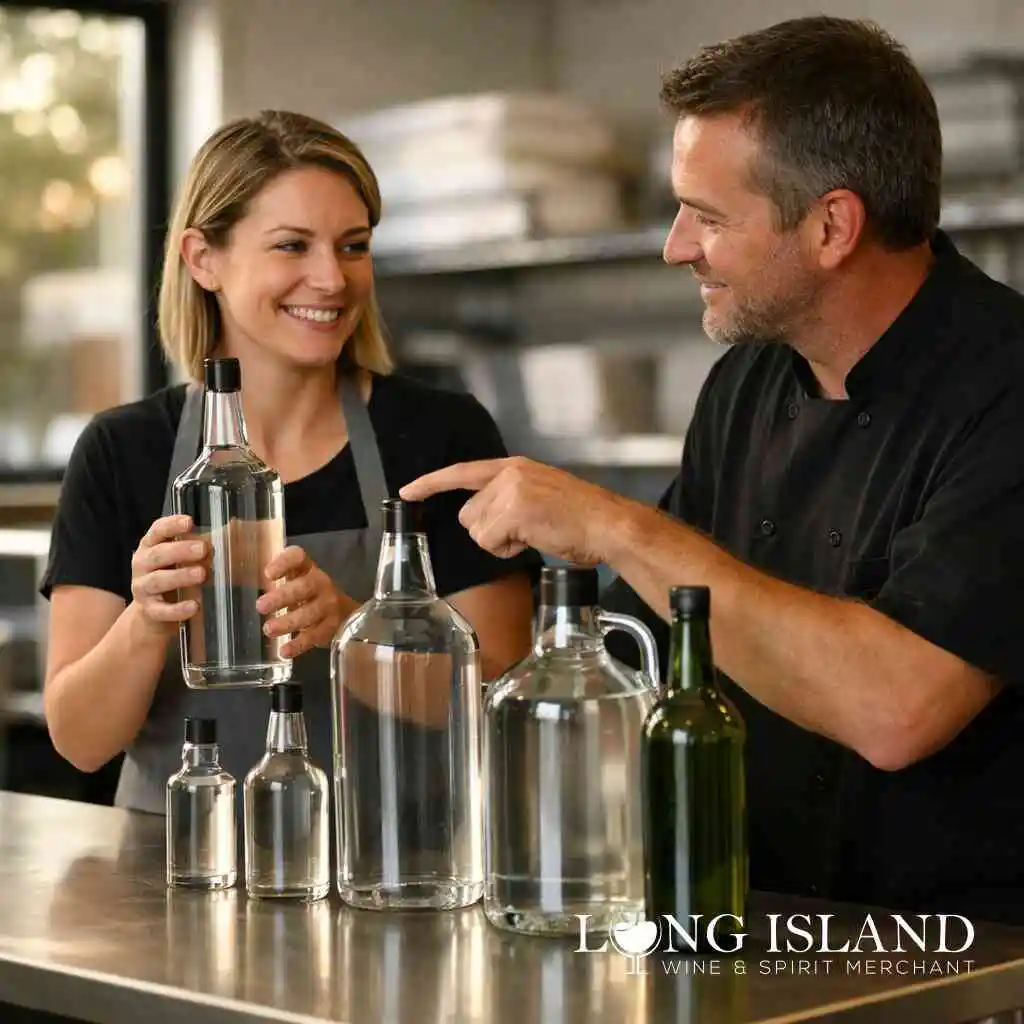
- Vodka
- Whiskey
- Rum
- Gin
- Tequila
- One or two modifiers, such as vermouth or liqueur
- A sparkling option for lighter cocktails
This keeps your bar versatile without turning it into a storage problem. It also lets you respond to different guest preferences. If you need help shaping the menu, how to stock a bar with essential spirits for cocktails is a practical resource. The goal is not to own every bottle. The goal is to serve the drinks people will actually order.
-
Wine, beer, and canned cocktails deserve their own bottle size strategy
When red wine, white wine, rosé, champagne, and sparkling wine should be planned separately from spirits
Wine behaves differently from spirits. Red wine, white wine, rosé, champagne, and sparkling wine should be planned as their own category. Guests often drink them at different points in the event. Sparkling wine may spike during the toast. Red and white wine may move steadily throughout dinner. That rhythm deserves separate counts.
For larger events, wine cases and bottle planning for weddings and events gives you a better planning frame than guessing bottle by bottle. If your menu includes champagne or sparkling wine, don’t blend that number into your spirit total. You will underbuy one category and overbuy another.
Why craft beer, imported beer, domestic beer, and hard seltzer need different case counts than liquor
Beer and canned drinks follow their own math. Craft beer, imported beer, domestic beer, hard seltzer, and canned cocktails usually move by case count, not bottle-size logic. The serving style is different. Guests may open beers earlier, then switch later. Some will stick with one category all night. That means your case mix should reflect your audience.
This is especially true for backyard catering and casual receptions in Suffolk County. A beer-heavy crowd needs more case planning than a cocktail crowd. If your event leans that way, red wine, white wine, rosé, champagne, and sparkling wine for catering is only part of the picture. You also need to match beer style and volume to the crowd.
How mini bottles for favors and gift liquor sets can support weddings, showers, and holiday events
Mini bottles for favors work beautifully when you want the bar to feel memorable. They are also useful in gift liquor sets and holiday liquor gifts. They can sit beside a welcome table, a dessert station, or a small thank-you display. In those cases, presentation matters as much as volume. Mini bottles can support the event without driving the pour plan.
If you want to build something special, gift liquor can make the event feel thoughtful. Just keep the roles clear. Favors are not the same as service stock. That distinction saves money and stress. It also keeps your caterer from running short on the drinks that matter.
-
The bottle size plan that keeps a Commack catering order moving smoothly
How to build a final order list that matches party planning, not just shelf habits
The best final order list starts with the guest count, then the menu, then the bottle sizes. Do not start with what you happen to like on the shelf. That approach feels comfortable, but it often misses the real service pattern. A better plan maps drinks to moments: welcome pours, dinner service, cocktail hour, and late-night refills. That is the logic behind top bottle size tips for catering in Commack NY 2026.
If you are in Commack, NY, it helps to think locally. Weather, traffic, and venue access all affect setup. Long Island events often need tighter timing than people expect. If you build your order around the event flow, not just the cabinet at home, you will feel the difference immediately.
When to use bulk liquor, wholesale liquor, or custom cases of wine for larger events
Bulk liquor and wholesale liquor options make sense when the guest count is high and the drink menu is stable. Custom cases of wine can also be smart for weddings and formal dinners. The point is not to buy more. The point is to buy in the format that reduces waste and keeps service efficient. That is especially helpful when you need multiple bottles of the same spirit.
A corporate host in Nassau County once told us the bar looked well stocked, but the service kept slowing down. The issue was not quantity. It was fragmentation. Too many small bottles meant too many handoffs. After the order shifted to a cleaner mix of large formats, the entire bar line moved faster.
The decision frame for Long Island liquor store pickup, liquor delivery in Commack, or shipping liquor to all states
Your last decision is logistics. Pickup works when you want control and immediate access. Liquor delivery in Commack helps when timing matters and the order is straightforward. Shipping liquor to all states can help when your guest list or event location makes local pickup harder. Each option has tradeoffs, and alcohol shipping laws always deserve a quick check.
If you want a practical route, liquor delivery in Commack for catering orders can be a strong fit for local service. If you are comparing a Long Island liquor store with online ordering, weigh convenience against lead time and order accuracy. The right plan is the one that gets the right bottles to the right place without drama. Start with one call, one menu, and one clear count. You do not need to figure every detail out today.
People Also Ask
What are the standard liquor bottle sizes in the US?
The most common standard liquor bottle sizes in the U.S. are 50ml, 100ml, 200ml, 375ml, 750ml, 1 liter, and 1.75 liter. In everyday language, people also say mini bottles, half pints, pints, fifths, and handles. For catering, the most useful sizes are usually 750ml, 1 liter, and 1.75 liter. Those sizes are easier to compare by ounce and usually work best for planning pours.
Is a half gallon the same as a handle?
No, not exactly. A handle usually means a 1.75 liter bottle, which is close to 59.2 ounces. A half gallon is 64 ounces, so it is larger. In conversation, people sometimes use the terms loosely, but they are not the same. For event planning, always check the printed milliliters or ounces.
How many 1.5 oz shots are in a liter of liquor?
A 1 liter bottle contains about 33.8 ounces. At 1.5 ounces per shot, that gives you roughly 22 shots. Real-world pours may vary a little, especially in cocktails with ice or mixers. Still, 22 is a reliable planning number for most events.
Does Shop Liquor Bottle Sizes ship mini bottles?
Shop Liquor Bottle Sizes offers shipping options, but you should always confirm what is available before ordering. Availability can vary by product and destination. If you are planning favors or tasting packs, check the product page and shipping details first. That keeps your event order accurate and avoids last-minute substitutions.
Which size is best for a wedding toast?
For a toast, 750ml bottles often work well if the guest count is modest. For larger weddings, 1 liter or 1.75 liter bottles can be more efficient. The right choice depends on whether you are pouring straight servings, mixing cocktails, or serving sparkling wine. If you are unsure, plan by guest count and expected toast volume.
Do bottle sizes change how much I should buy for cocktails?
Yes. Bottle size changes your total ounce count, which directly affects how many drinks you can serve. It also changes labor, storage, and refill frequency. Larger bottles usually improve value per ounce, while smaller bottles can help with variety or favors. For catering, that tradeoff matters more than most people expect.
Frequently Asked Questions
Question: How do I choose the best liquor bottle sizes for catering in Commack, NY when planning for a crowd?
Answer: The easiest way to choose liquor bottle sizes is to plan around pours, guest count, and drink menu instead of just looking at labels. For most catering bottle size planning, the standard bottle sizes that matter most are 750ml liquor, 1 liter liquor, and 1.75 liter liquor because they make pricing per ounce and bottle count estimates much clearer. A 750ml bottle is about 25.4 ounces, a 1 liter bottle is about 33.8 ounces, and a 1.75 liter bottle is about 59.2 ounces, so you can quickly estimate how many shots in a bottle based on a 1.5 ounce shot size. That approach is especially helpful for Commack catering liquor needs because it keeps the order practical for vodka, whiskey, rum, gin, tequila, and other essential spirits for events. If you are comparing options through a Long Island liquor store or want to buy liquor online, Shop Liquor Bottle Sizes can help you think through value size comparison without guessing.
Question: What is the difference between a fifth of liquor, a 750ml liquor bottle, and a handle of liquor for party planning?
Answer: A fifth of liquor is the older term people still use for a bottle close to 750ml, which is now the modern standard bottle size. A 750ml liquor bottle is the everyday baseline for many spirits, while a 1.75 liter liquor bottle, often called a handle of liquor, gives you much more volume and usually a better pricing per ounce for high-demand mixed drinks. A half gallon liquor bottle is larger still, but it is not the same as a handle, so it is important to check the printed milliliters or ounces instead of relying on historical bottle names alone. This matters in bar inventory planning because smaller formats like pint liquor, half pint liquor, mini liquor bottles, airplane bottles, and nip bottles are useful for sampling or favors, while larger formats are better for service. If you are comparing standard bottle sizes for a Commack liquor store pickup or liquor delivery in Commack, Shop Liquor Bottle Sizes can help you match the bottle to the event rather than the shelf habit.
Question: How many shots in a bottle should I expect when buying liquor bottle sizes for cocktails?
Answer: A good planning number is 1.5 ounces per shot, which is the standard bartending measure used for estimating how many drinks a bottle can produce. Using that shot size, a 750ml liquor bottle gives you about 17 shots, a 1 liter liquor bottle gives you about 22 shots, and a 1.75 liter liquor bottle gives you about 39 shots. Those numbers are especially useful when you are stocking vodka, whiskey, bourbon, rum, gin, tequila, mezcal, or other types of spirits for mixed drinks because they make liquor size chart comparisons easy. It also helps with ml to oz conversion and avoids confusion between metric vs imperial sizing. If your event includes cocktails with mixers, ice, or garnish, the real number may shift a little, but this is still one of the most reliable tools for alcohol quantity planning.
Question: Which types of spirits should I prioritize when I want to stock a bar for a Commack catering order?
Answer: For most party planning and home bar setup decisions, the best place to start is with flexible essential spirits for events such as vodka, whiskey, rum, gin, and tequila. These bottles work with the widest range of cocktail ingredients and are easier to build around than niche bottles. After that, you can add specific options like bourbon, scotch, rye whiskey, spiced rum, mezcal, brandy, cognac, vermouth, sweet vermouth, dry vermouth, amaro, or liqueur only if the menu calls for them. That is where bar inventory planning becomes more efficient, because you avoid overbuying specialty bottles that may not move. For a catering setup in Commack, NY, Shop Liquor Bottle Sizes can help you think through which liquor bottle sizes support your menu, whether you are shopping for a Long Island liquor store pickup, alcohol near me convenience, or buying liquor online.
Question: How does Top 7 Bottle Size Tips for Catering in Commack NY 2026 help me decide between mini liquor bottles, wine, beer, and bulk liquor?
Answer: Top 7 Bottle Size Tips for Catering in Commack NY 2026 is useful because it separates different service categories instead of treating everything like one big liquor order. Mini liquor bottles, airplane bottles, and nip bottles are great for mini bottles for favors, gift liquor, or liquor gift sets, but they are not efficient as the main service stock. Wine, including red wine, white wine, rosé, champagne, and sparkling wine, should be planned separately because guests consume it differently from spirits. Beer, craft beer, imported beer, domestic beer, hard seltzer, and canned cocktails usually work better by case count rather than bottle-size math. For larger events, bulk liquor and wholesale liquor options can make service smoother, especially when you want fewer bottle changes and cleaner bar service essentials. That kind of planning is exactly why Shop Liquor Bottle Sizes is a helpful online liquor store for Commack catering liquor needs and broader Long Island liquor store shopping.


