
How to Compare 1.75 Liter Liquor Value for Suffolk Events
August 9, 2026
You need to buy liquor for a party, but the bottle sizes are not lining up cleanly. That confusion is normal. If you are staring at a handle and wondering whether it really beats a fifth, you are already asking the right question. For Suffolk events, the answer depends on pricing per ounce, serving count, and how quickly guests will actually pour.
Why the handle looks like the bargain until Suffolk event math changes the picture
A 1.75 liter liquor bottle often looks like the obvious winner. It is the big bottle. It feels efficient. Still, the best choice depends on your guest list, your bar setup, and how much variety you want to offer. If you are planning a backyard gathering in Commack, that math can change fast.
What a 1.75 liter bottle really means in liquor bottle sizes and standard bottle sizes
In liquor bottle sizes, the 1.75 liter bottle is the familiar handle of liquor. It is one of the most common standard bottle sizes for larger home stock and party use. In metric terms, it holds 1,750 ml. In practical terms, it is built for hosts who want fewer bottles and more volume.
That size matters because liquor math gets messy when people guess. A 1.75 liter bottle is larger than a fifth of liquor and much larger than a 750ml liquor bottle. Many readers think “biggest bottle equals best value,” and that is sometimes true. However, the real answer shows up only after you compare ounces, servings, and bottle count.
Here is the part most hosts miss: bigger bottles do not always fit the event. At a small dinner, a handle can leave you with extra open liquor after the party ends. At a longer Suffolk County barbecue, it can save you from a frantic run for more ice, mixers, and backup bottles.
We hear this from customers who want to stock a bar for events without overbuying. The question is rarely about volume alone. It is about matching bottle size to the rhythm of the night. That is where liquor bottle sizes become a planning tool, not just a label decision.
How many shots in a bottle when you compare a handle of liquor to a fifth of liquor and 750ml liquor
A standard shot is usually considered 1.5 oz in American bartending. That is the baseline most hosts use when asking how many shots are in a bottle. A 750ml bottle gives you about 17 shots. A 1.75 liter bottle gives you about 39 shots. A fifth of liquor, at 750ml, is the classic benchmark because it is easy to estimate and easy to pour.
That makes the handle of liquor look powerful. It roughly gives you more than double the pours of a fifth. If you are serving vodka sodas, whiskey and ginger, or tequila with citrus mixers, that difference can matter a lot. It also helps when you are building a home bar that needs one bottle to cover an entire evening.
Still, shot count alone can mislead you. If your guests drink cocktails with two ounces of spirit, your count drops quickly. If your recipe uses vermouth, amaro, or liqueur, the bottle stretches differently. That is why a simple shot calculation should always sit beside the actual menu.
A client in Smithtown once planned a backyard birthday with three cocktail options and a beer cooler. He assumed two handles would cover everything. Once we walked through the pours, he realized one handle of vodka and one 750ml bottle of whiskey would serve better than three mixed large bottles. That small adjustment saved him from unopened extras and made the bar easier to manage.
Why pricing per ounce matters more than shelf sticker shock for party planning and bar inventory
Shelf sticker shock can trick even careful shoppers. A handle costs more at checkout, so people often flinch first. But pricing per ounce tells the real story. If the larger bottle drops the cost per ounce enough, you may get stronger value even if the total bill looks higher.
That is why smart party planning starts with the ounce math. You should compare the total ounces in each bottle, then divide by the total price. The lower number wins on value, assuming the spirit quality and ABV are comparable. This method works for bar inventory too, because it shows what you are really paying to keep shelves ready.
A simple value size comparison looks like this:
Bottle sizeApprox. ouncesTypical use750ml liquor25.4 ozSmall gatherings, varied spirits1 liter liquor33.8 ozMedium events, balanced value1.75 liter liquor59.2 ozBigger events, core well spiritsThis is also where ABV and proof matter. ABV means alcohol by volume. Proof is twice the ABV in the U.S. A higher-proof bottle can stretch differently in cocktails, but your pour size still drives the math. If you are serving neat whiskey, the number of drinks changes even more.
For hosts in Commack and across Suffolk County, this kind of math can keep the liquor delivery order cleaner. It helps you buy what you need, not what merely looks impressive. That is a better use of budget than chasing sticker shock.
When mini liquor bottles airplane bottles and half pint liquor make more sense than one large bottle
Sometimes the handle is not the best tool. Mini liquor bottles, airplane bottles, and half pint liquor can make far more sense. They shine when you need portion control, favors, sampling, or variety. They also reduce waste when not every guest drinks the same spirit.
Mini bottles are useful for weddings, giveaways, and favor tables. They are also ideal when you want guests to choose between vodka, rum, or tequila without opening multiple full-size bottles. Airplane bottles work well for individual packs or themed gift liquor sets. A half pint can fit a small bar or a tasting setup with less commitment.
The smartest hosts use smaller bottles for flexibility and larger bottles for core pours. That usually means handles for house vodka, whiskey, or rum, plus minis for specialty items. In a busy Suffolk County event, that balance can keep the bar moving. It also helps you avoid half-open bottles cluttering the counter.
On the projects and orders we see most often, variety drives better guest satisfaction than raw bottle size. That is especially true when you have wine drinkers, beer drinkers, and cocktail drinkers at the same table. For those events, the handle is only one piece of the plan.
The bottle size comparison that separates smart hosts from overbuying near the last hour
The biggest mistakes happen late. People realize they need more liquor after the store trip is done, or after the ice is already melting. That is why a clear bottle comparison matters before you shop. If you know the size ladder, you can avoid overbuying and still keep the bar stocked.
How to use a liquor size chart and ml to oz conversion without getting tripped up
A liquor size chart helps you compare bottles fast. The trick is to keep ml to oz conversion simple. Roughly, 30 ml equals 1 oz. That makes 750ml about 25.4 oz, 1 liter about 33.8 oz, and 1.75 liter about 59.2 oz. You do not need a calculator every time if you remember those anchors.
This is where many people get stuck. They compare label numbers without converting units. A 1 liter bottle can feel close to a 750ml bottle if you are rushing, but it is meaningfully larger. The same mistake happens with wine and beer when people mix serving styles. A little conversion knowledge saves a lot of guesswork.
If you want a fast planning method, use these steps:
- List the spirits you actually need.
- Estimate drinks per guest.
- Convert bottle sizes to ounces.
- Divide by your pour size.
- Buy one backup bottle only where demand is highest.
That process works well for home bartending and larger events. It also keeps the shopping list focused when you are buying from a Long Island liquor store or choosing to buy liquor online from a trusted source.
Where 1 liter liquor and half gallon liquor fit into the value size comparison
A 1 liter liquor bottle is the middle child of the shelf. It is often the smartest size when you need more than a fifth but do not want a handle. It gives you better volume than 750ml without jumping all the way to 1.75 liters. For a small dinner party or a limited bar, that can be the cleanest compromise.
Then there is half gallon liquor, which sits closer to the handle idea in everyday conversation. People sometimes use that phrase loosely, but the important part is volume, not nickname. Larger bottles generally improve value per ounce, but only if you will use the liquid before it loses freshness or becomes dead stock.
Here is a practical comparison for hosts:
SizeBest useValue feeling750ml liquorSmall bar, mixed spiritsFlexible1 liter liquorMid-size gatheringStrong balance1.75 liter liquorLarger parties, core spiritsBest for volumeIf you are building a bar inventory, the 1 liter bottle is often overlooked. That is a mistake. It can fill the gap between “too little” and “too much.” For Suffolk hosts, that middle ground can be the difference between a tidy bar and a crowded counter.
The real role of double magnum jeroboam rehoboam methuselah salmanazar balthazar and nebuchadnezzar in event planning
Those giant names get attention for a reason. Double magnum, jeroboam, rehoboam, methuselah, salmanazar, balthazar, and nebuchadnezzar are historical bottle names that mostly matter in wine and champagne planning. They are not everyday party bottles, but they do teach scale. They remind you that bottle size choices have a long history tied to celebration and presentation. For most Suffolk events, these sizes are not your purchase target. Still, they matter when you are planning a formal toast, a wedding-style display, or a special gift liquor setup. Large-format bottles look dramatic, but they are rarely the most practical bar solution. They can also be harder to store, chill, and transport. If you are comparing them to standard liquor sizes, think of them as specialty pieces. They belong in the same conversation about event planning, but not in the same shopping lane. A handle of vodka or whiskey is far more useful for daily service. A methuselah is for spectacle. 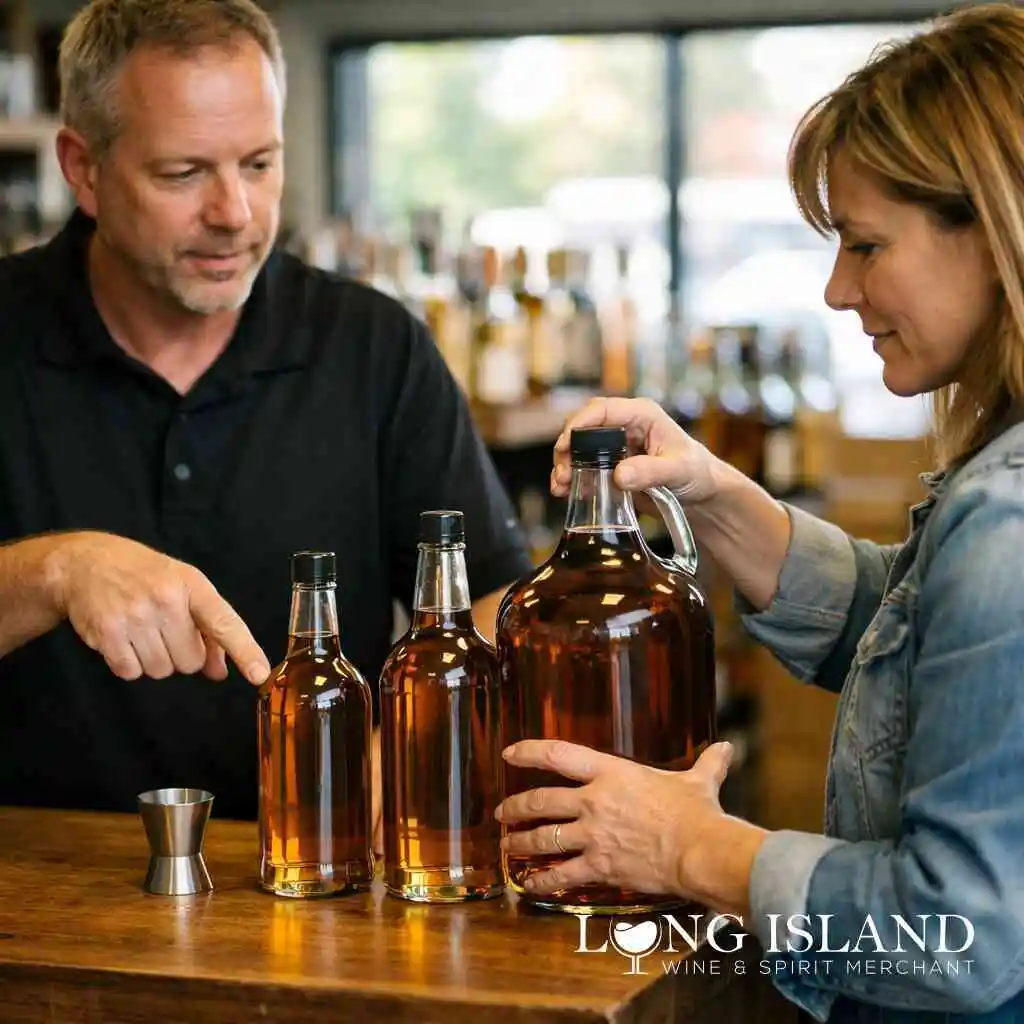
That is why liquor bottle reuse and eco-friendly bottle sizes sometimes enter the conversation too. Smaller bottles can be repurposed more easily for syrups, tastings, or display. Large bottles are efficient, but they are not always flexible.
Which types of spirits usually justify larger buys such as vodka whiskey bourbon scotch rum gin and tequila
Some types of spirits deserve larger bottles more often than others. Vodka, whiskey, bourbon, scotch, rum, gin, and tequila are the usual candidates. These spirits anchor cocktails and often get poured repeatedly throughout the night. If your crowd drinks mixed drinks, larger sizes make practical sense.
Vodka is often the safest handle purchase because it mixes with almost anything. Whiskey and bourbon also work well because they can cover neat pours and classic cocktails. Rum is especially useful when you are making punches, tiki drinks, or simple highballs. Gin and tequila make sense if your menu centers on martinis, gin and tonics, margaritas, or palomas.
Spiced rum, rye whiskey, mezcal, brandy, cognac, vermouth, amaro, and liqueur usually need a more selective buy. These are often supporting spirits, not volume leaders. If you overbuy them, they sit untouched. If you underbuy vodka or tequila, the bar line grows fast.
That is why a good Commack liquor store or online liquor store should help you balance essential spirits against specialty items. For many hosts, one big bottle and several smaller support bottles work better than a shelf full of oversized purchases.
What Suffolk County hosts should check before they stock the bar and close the order
Suffolk County events have their own rhythm. The guest count matters, of course. But so do weather, venue style, and how far the drinks need to travel. A plan that works in a tight indoor space may fail on a breezy Long Island patio.
How local party size weather and venue style in Commack Long Island Suffolk County and Nassau County change the best liquor bottle size for parties
Local conditions shape bottle choices more than people expect. A small house party in Commack is different from a large tented event in Suffolk County. Nassau County gatherings often look similar on paper, but layout and service flow can be very different. Long Island weather also pushes hosts toward simple, fast-pour bar setups.
Hot weather increases ice use and mixer volume. That can make larger spirit bottles even more useful, because cocktails go faster in warm conditions. At the same time, outdoor events may need more backup ice, more chilled water, and fewer obscure spirits. A tighter menu usually beats an elaborate one when guests are moving between yard, deck, and patio.
I have seen hosts overestimate how much variety people want. One small holiday gathering near Huntington had six spirits lined up. Guests mostly drank vodka, wine, and beer. The extra bottles never opened. The host said later that one handle, one 1 liter bottle, and a few minis would have been enough.
This is the local advantage of working with a Commack liquor store that understands Suffolk and Nassau event patterns. The right size is not just about ounces. It is about how people actually drink where you are hosting.
When liquor delivery convenience beats a last minute store run and why it matters for busy hosts
A last-minute store run sounds simple until the clock starts shrinking. That is where an online liquor store can be the better move. You can compare liquor bottle sizes, check your spirit list, and make sure the order matches the bar plan before you commit. That saves time and reduces panic buying.
Liquor delivery matters most when your weekend is already full. If you are managing food, seating, and ice, the last thing you want is another errand. Ordering ahead also helps when you need bulk items, gift liquor, or custom cases. It lets you focus on the guest experience instead of traffic.
For buyers in Commack, Long Island, and nearby Suffolk County neighborhoods, convenience is not a luxury. It is often the difference between calm hosting and a rushed scramble. If you need to compare options quickly, the liquor bottle sizes for Long Island event planning page is a solid place to start.
That said, delivery rules and alcohol shipping laws still matter. Always check what is permitted for your order and location. A reliable shop should make those boundaries clear without confusing you.
How to compare liquor value for wine beer craft beer hard seltzer and canned cocktails without mixing up serving math
Liquor is only part of the bar. You also need to compare wine, beer, craft beer, hard seltzer, and canned cocktails carefully. The mistake is assuming every drink works from the same math. It does not. Wine pours by the glass. Beer serves by the can or bottle. Cocktails depend on recipe strength and garnish.
A smart value size comparison starts with drink style. A 750ml wine bottle gives about five standard glasses. A beer case serves differently depending on bottle size and style. Hard seltzer and canned cocktails can disappear fast because guests treat them like easy grab-and-go options. That means the “best value” item is not always the bottle with the lowest sticker shock.
For mixed events, think in categories:
- Wine for dinner pacing and older guest preferences
- Beer and craft beer for casual, longer stays
- Hard seltzer for lighter drinkers
- Canned cocktails for convenience and speed
- Liquor for flexibility and cocktail control
If you are still deciding between a handle and a case of wine, remember this: the best plan usually uses both. That is where wine cases for party stock and bar inventory can complement a spirit order well.
The next move for buyers who want to stock a bar with confidence using bulk liquor gift liquor or custom cases of wine
The next move is simple. Build the bar around your most-consumed spirits, then layer in specialty items. Use bulk liquor for the core pours, gift liquor for the moments that need presentation, and custom cases of wine for the guests who prefer something slower and easier. That mix gives you control without clutter.
If you want more confidence, start with your guest count and drink style, then choose bottle sizes from there. A handle is not always the winner, but it often is for high-volume vodka, whiskey, or tequila. A 1 liter bottle can be smarter for mid-size hosting. Minis and half pints can fill the gaps beautifully.
Shop Liquor Bottle Sizes is built for this exact decision. Based in Commack, New York on Long Island, the store helps hosts compare bottles without turning the process into guesswork. If you want a clearer way to compare 1.75 liter liquor value in Suffolk County, you can use that framework before you order. You can also start by checking the shot counts and ml to oz conversion for liquor bottles guide and then match the math to your own guest list.
You do not have to buy everything at once, and you do not have to figure it out alone. Start with one spirit, one serving estimate, and one bottle-size comparison. Then place the order that fits your bar, your people, and your space.
Frequently Asked Questions
Question: How do I compare 1.75 liter liquor value against 750ml liquor and 1 liter liquor for party planning in Suffolk County?
Answer: The easiest way to compare liquor bottle sizes is by using pricing per ounce and matching it to your guest count. A 1.75 liter liquor bottle, also called a handle of liquor, usually gives you far more pours than a fifth of liquor or 750ml liquor, so it often delivers stronger value when you need volume for a home bar or stock a bar for events. A 1 liter liquor bottle can be the middle-ground option, while a 750ml bottle is often better for smaller gatherings or more variety. For Suffolk County liquor planning, the best bottle is not always the biggest one. It is the one that fits your menu, your pour size, and how many drinks you expect to serve. Shop Liquor Bottle Sizes helps you compare these standard bottle sizes clearly so you can buy with confidence instead of guessing.
Question: How many shots in a bottle should I expect from a handle of liquor, and does ABV or proof change the math?
Answer: In most home bartending and party planning situations, a standard shot is about 1.5 oz, so the question of how many shots in a bottle starts with simple ml to oz conversion. A 750ml liquor bottle usually gives about 17 shots, while a 1.75 liter liquor bottle gives about 39 shots. If you are comparing a fifth of liquor to a handle of liquor, the handle gives you more than double the pours. ABV and proof matter too, especially if you are serving neat spirits or stronger cocktails, because higher-proof liquor can change how people experience each drink. For vodka, whiskey, bourbon, rum, gin, or tequila, checking the bottle size and the expected pour is the best way to avoid running short. Shop Liquor Bottle Sizes makes that kind of liquor size chart planning simpler for Suffolk County and Long Island hosts.
Question: What types of spirits make the most sense to buy in bulk liquor or larger standard bottle sizes?
Answer: Larger bottles usually make the most sense for essential spirits that get poured often, especially vodka, whiskey, bourbon, scotch, rye whiskey, rum, spiced rum, gin, and tequila. These are the core types of spirits that tend to anchor cocktails at weddings, backyard parties, holiday gatherings, and other Suffolk County events. If your menu includes mixer-heavy drinks like vodka sodas, gin and tonics, whiskey and ginger, or margaritas, a larger bottle can improve value size comparison and reduce the number of refills you need during service. Specialty spirits like mezcal, brandy, cognac, vermouth, amaro, or liqueur are often better bought in smaller quantities unless you know they will be used heavily. Shop Liquor Bottle Sizes is designed to help you choose the right mix of bulk liquor, mini liquor bottles, airplane bottles, and half pint liquor options based on how your guests actually drink.
Question: When should I choose mini liquor bottles, airplane bottles, or half pint liquor instead of a 1.75 liter liquor bottle?
Answer: Mini liquor bottles, airplane bottles, nip bottles, and half pint liquor sizes are a smart choice when you want portion control, favors, tasting sets, or variety without opening full-size bottles. They are especially useful for mini bottles for favors, gift liquor, or events where not everyone drinks the same spirit. A 1.75 liter liquor bottle is great for high-volume pours, but smaller bottles can be better if you are serving a range of guests who prefer different options, such as vodka, whiskey, wine, beer, hard seltzer, or canned cocktails. If your event is more about presentation and flexibility than volume, smaller liquor bottles may actually be the better buy. Shop Liquor Bottle Sizes offers a range of liquor bottle sizes so Long Island hosts can match bottle choice to the event instead of forcing every occasion into one format.
Question: How does How to Compare 1.75 Liter Liquor Value for Suffolk Events help me stock a bar for events without overbuying?
Answer: That guide is built to help Suffolk hosts compare liquor bottle sizes using practical event planning, not guesswork. It shows how to use a liquor size chart, ml to oz conversion, and pricing per ounce to decide whether a handle of liquor, 1 liter liquor, or 750ml liquor bottle is the smartest option for your guest list. It also explains when wine, beer, craft beer, hard seltzer, and canned cocktails should be part of the order so you are not depending only on spirits. For many events, the best way to stock a bar for events is to combine essential spirits with a few smaller support bottles, then use custom cases of wine or bulk liquor where needed. Shop Liquor Bottle Sizes, also known as Long Island Wine & Spirit Merchant, gives Commack and Suffolk County shoppers a practical way to buy liquor online, compare value size comparison options, and build a bar inventory that feels organized and well planned.


